BetterSlides - Slide into a better life with better slides
- 2 mins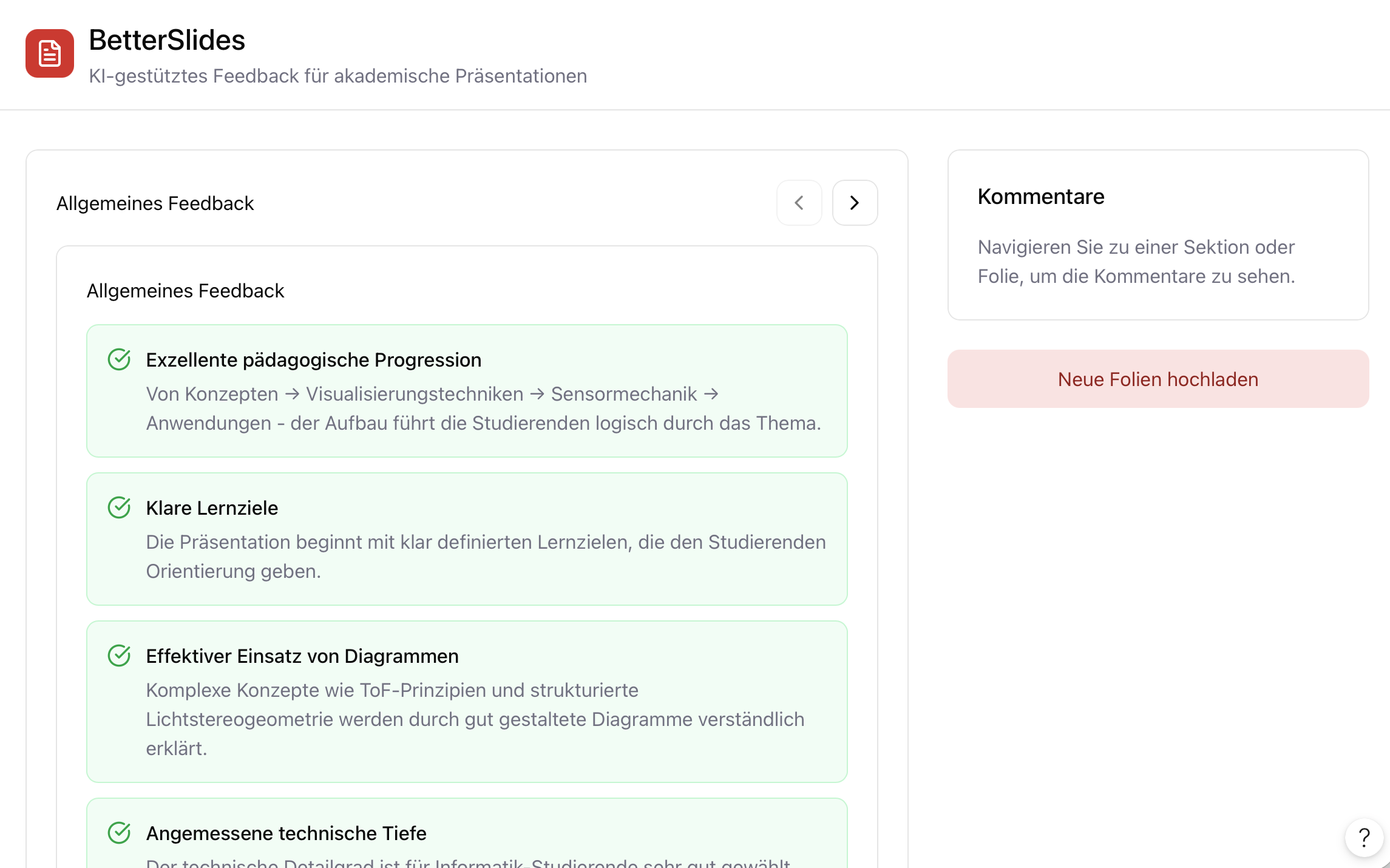
How well do your lecture slides actually communicate your learning goals? Are they cognitively overwhelming or just right? BetterSlides addresses exactly these questions. The project develops an AI-powered web application that automatically analyzes and evaluates presentation slides and other teaching materials assessing both their didactic quality and the cognitive load they impose on learners.
Educators today invest significant effort in preparing their materials, yet objective, automated feedback tools for slide quality simply do not exist. BetterSlides fills this gap by bringing together large language models, computer vision, and neurocognitive sensing into a single, easy-to-use platform.
The Problem
Modern university teaching relies heavily on slide-based presentations. While instructors are generally aware of good design principles, consistent application fails in practice largely due to a lack of feedback and objective assessment tools. Key questions remain unanswered:
- Are learning objectives clearly communicated on each slide?
- Is the textual and visual complexity appropriate for the audience?
- Which slide elements attract visual attention and in what order?
- How long does it actually take to read and process the content?
- Are the materials accessible for students with color vision deficiencies?
Our Approach
BetterSlides tackles these challenges in three progressive development stages:
Phase 1: Language & Learning Objective Analysis (WP1)
Using state-of-the-art Large Language Models (e.g., GPT-4), the system performs automated analysis of each slide’s textual content. This includes:
- Clarity and completeness of communicated learning objectives
- Textual complexity (sentence structure, bullet depth, nesting)
- Linguistic consistency across the full slide set
- Constructive alignment checks matching lecture content with lab tasks and exam questions, categorized by cognitive level (reproduction, application, transfer)
Results are displayed as interactive visualizations directly in the web application.
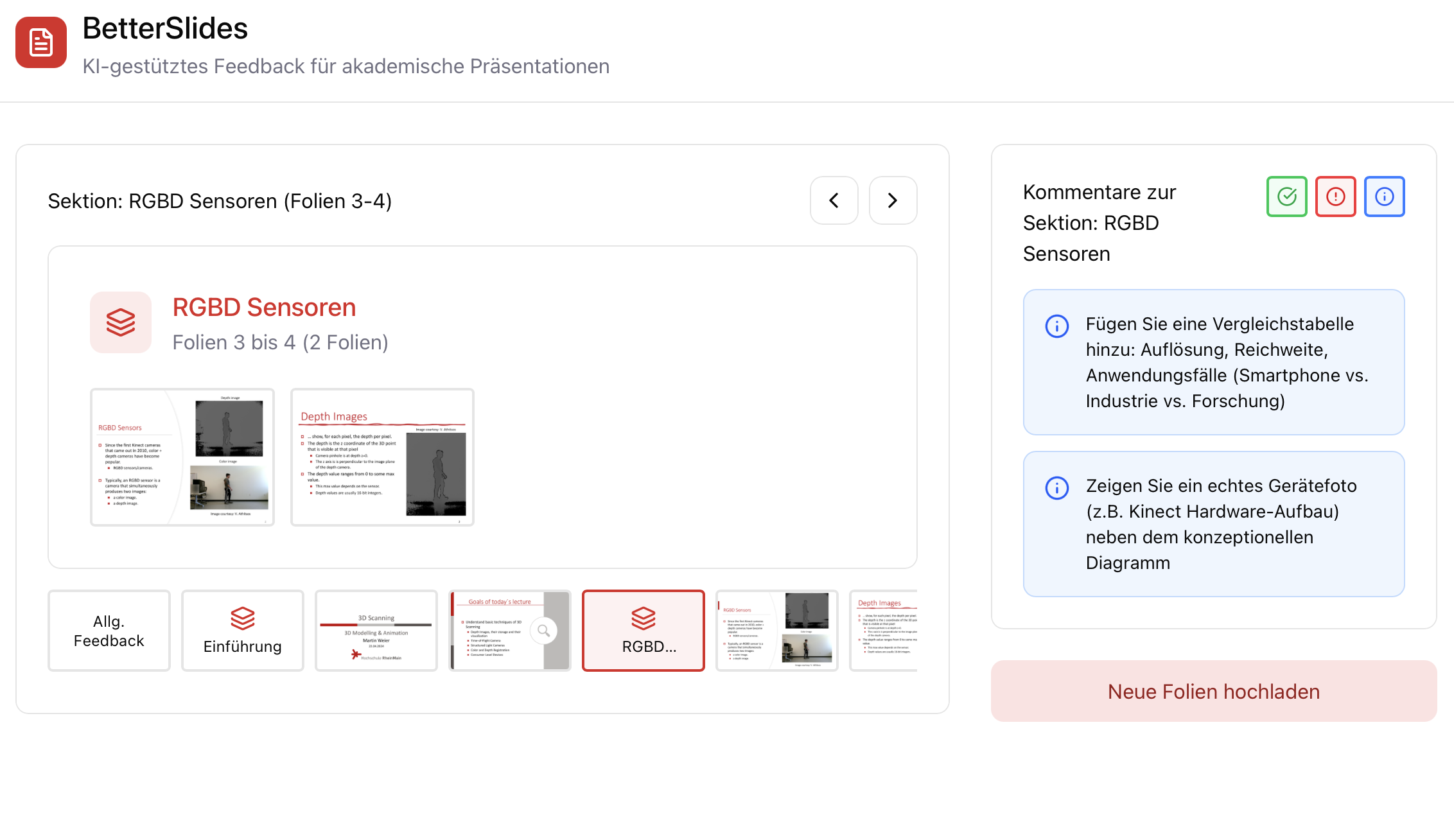
Phase 2: Visual Perception & Saliency (WP2)
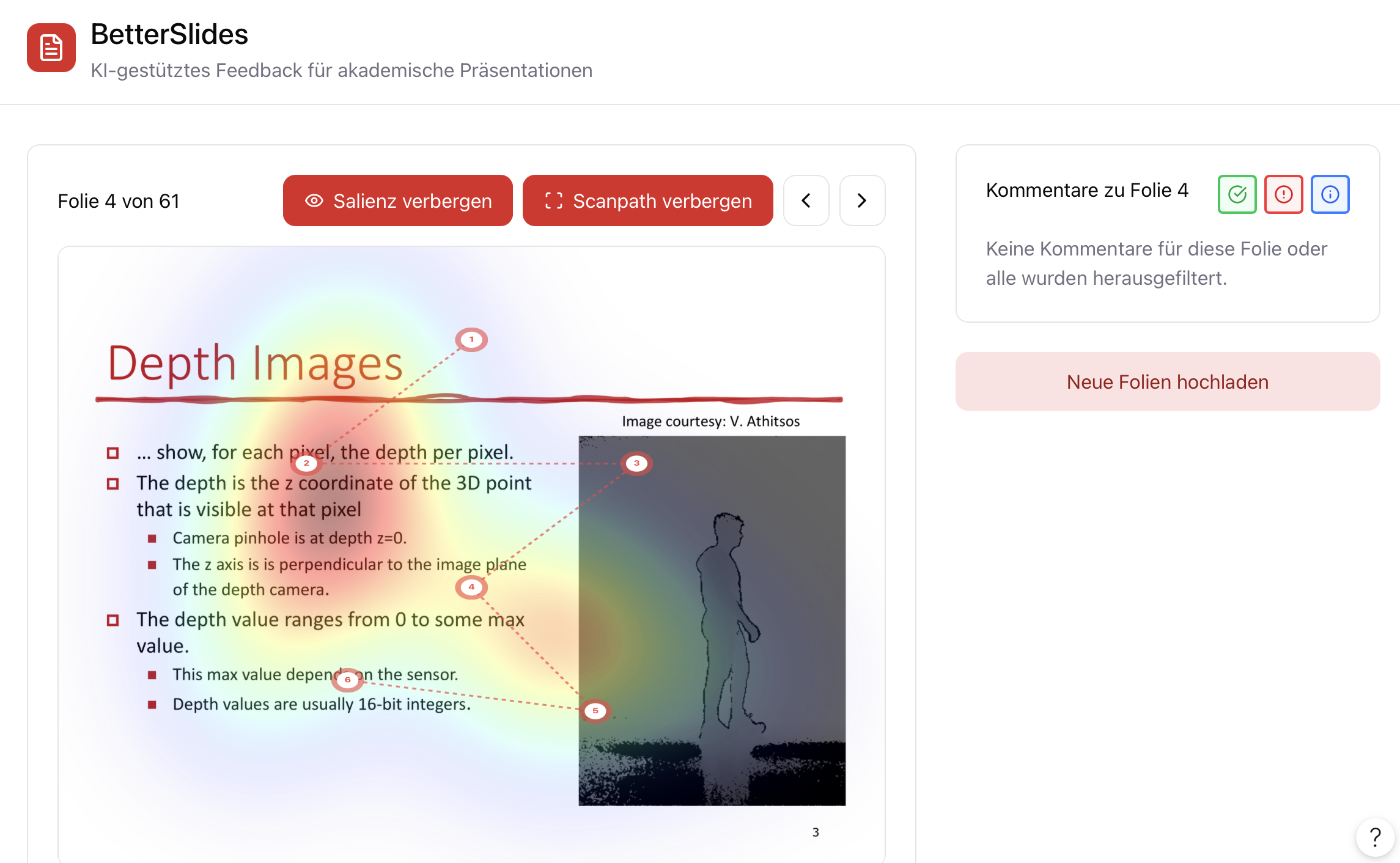
Building on Phase 1, the system integrates perceptual AI models to evaluate the visual quality of slides:
- Visual saliency calculation using neural models (e.g., SalNet, SalGAN) to identify which elements attract the eye
- Scan-path prediction (e.g., PathGAN) to model how viewers visually navigate a slide
- Estimated reading time per slide
- Image complexity metrics via computer vision: Shannon entropy, edge density, text-to-image ratio, object density
- Accessibility checks: color contrast analysis and simulation of color vision deficiencies, with suggestions for accessible alternatives
Phase 3: Cognitive Load Measurement (WP3)
In the final phase, the project trains custom neural networks on real physiological data:
- Eye-tracking data (fixations, saccades, pupil dilation, blink rates)
- Biometric sensors (galvanic skin response, GSR)
This enables real-time estimation of cognitive load and learner engagement. The core research hypothesis: can the AI and perceptual models from earlier phases reliably predict cognitive load without requiring sensors during regular use?
Expected Outcomes
- A web-based analysis tool that delivers objective, actionable feedback on slide design and didactic structure
- Reduced cognitive load in student-facing materials, leading to better learning outcomes and exam preparation
- A modular, transferable system that can be adopted across courses and departments university-wide
- A foundation for adaptive learning systems that dynamically adjust content complexity to individual learners’ cognitive state benefiting students with learning difficulties in particular
Duration
ongoing